Judo & JiuJitsu Terms & Definitions
Judo & JiuJitsu Terms for Beginners
General Judo & JiuJitsu Terms for White and Yellow Belts
– Judo: Gentle Way, coming from “Ju” meaning “Gentle”, and “Do” meaning “Way”
– JiuJitsu: Gentle Art, coming from “Ju” meaning “Gentle”, and “Jitsu” meaning “art” or “technique”… alternate spellings include Jujutsu, Jujitsu, and Jiu-Jitsu
– Dojo: Place of the Way – a place to practice/learn “the way”. A martial arts school.
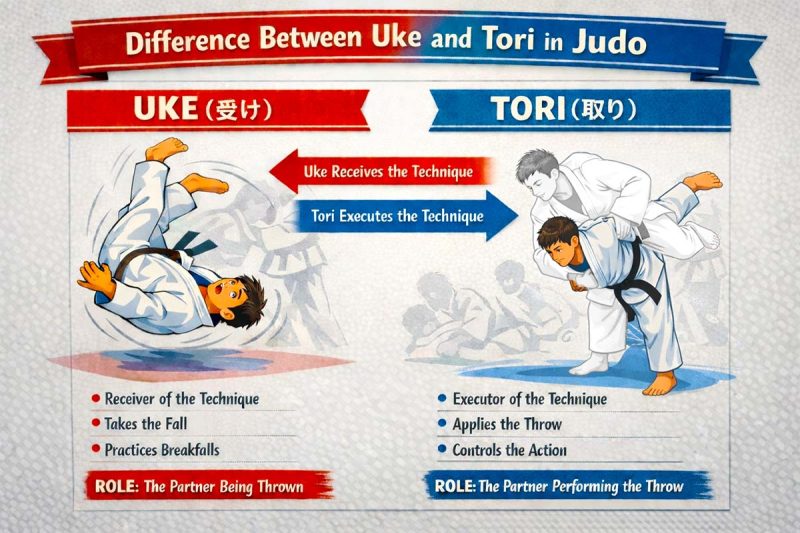
– Tori: Taker – the person performing the technique
– Uke: Receiver – the person “receiving” the technique, i.e. the one being thrown, pinned, choked, or locked
– Gi or Judogi: The Judo uniform
– Obi: Belt
– Tatami: Mat
– Seiza: kneel down
– Joseki: Seat or Place of Honor – at Kodokan Judo & Jiujitsu in Cape Coral, this is the side of the dojo where the mirrors are
– Sensei: Teacher or Instructor, literally “one who has gone before”
– Rei: Bow
– Joseki ni Rei: Bow to the place of honor
– Sensei ni Rei: Bow to the Instructor
– Jigoro Kano: The founder of Judo. Created Judo in 1882, establishing the Kodokan Dojo in Tokyo, Japan
Judo & JiuJitsu Terms for Competition
Judo & JiuJitsu Terms for Competition
– Hajime: Begin – The referee’s command to start the contest or to resume it after a pause
– Matte: Stop or Wait – The referee’s command to temporarily halt the contest.
– Yoshi: Good or Continue – A command used most commonly in Ne Waza to signal players to continue when they have paused momentarily or when the referee allows a throw that didn’t score cleanly to transition into ground work.
– Sore Made: That is All or Until Now – The referee’s command signaling the end of the contest
– Ippon: Full Point, the highest score in Judo, immediately ending the contest in victory
– Waza-ari: Half Point, the second-highest score in Judo, two Waza-aris can combine for an Ippon and a victory
– Yuko: Quarter Point, the lowest score in Judo. Yukos do not combine to equal Waza-aris or Ippons.
– Osaekomi: Holding – The referee’s call signaling that a valid pin has been established and begins the pin clock.
– Toketa: The hold has been broken. The referee’s call stopping the pin clock when the defending player successfully escapes or turns into a position where the hold is no longer valid
– Shido: Penalty
– Hansoku-make: Disqualification; a loss by rule violation.
– Golden Score: Sudden-death overtime
Judo & JiuJitsu Terms for Intermediates
Judo & JiuJitsu Terms for Orange Belt and Beyond
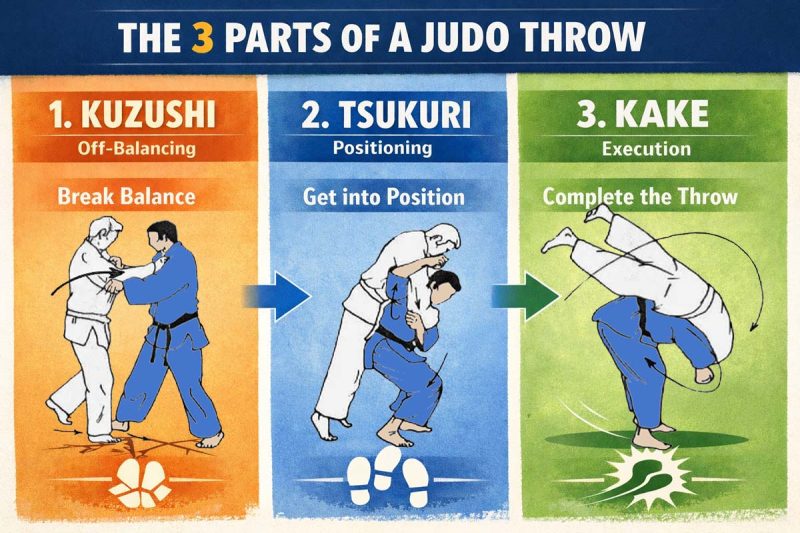
– The 3 Elements of a Throw…
1) Kuzushi – Breaking Balance
2) Tsukuri – Fitting in/Setup – entering and positioning the body correctly for a throw
3) Kake – Execution or Application – the moment you commit and complete the throw
– Shizentai: Natural posture, the basic standing position in Judo with the feet approximately shoulder-width apart, weight balanced equally on both feet, the knees slightly flexed, and the back upright with a relaxed, alert carriage
– Ukemi: Breakfalls – The four primary Ukemi are: Ushiro Ukemi (back breakfall), Yoko Ukemi (side breakfall), Mae Ukemi (front rolling breakfall), and Mae Mawari Ukemi (front rolling fall/forward roll)
– Nage Waza: Throwing techniques
– Ne Waza: Ground techniques
– Osaekomi Waza: Hold Down techniques
– Shime Waza: Choking techniques
– Kensetsu Waza: Joint locking techniques
– Sutemi Waza: Sacrifice throwing techniques – throws where Tori deliberately falls to the mat in order to execute a throw (eg. Tomoe Nage or Ura Nage)
– Tachi Waza: Standing throwing techniques – throws executed while both players are upright (eg. Seoi Nage). A sub-division of Nage Waza. Tachi Waza are divided into three families: Te Waza (hand techniques), Koshi Waza (hip techniques), and Ashi Waza (foot and leg techniques)
– Tai Sabaki: Body movement; pivoting and rotating the body for throws or evasions
– Randori: Free practice, live sparring – both partners attacking and defending freely, applying techniques at full or near-full resistance
– Uchi Komi: Repetition drilling – practicing the entry of a throw without completing the throw itself
– Shiai: A contest, match, competition
Judo & JiuJitsu Facts & Info to Know for Grading
Sensei will often ask questions during grading. In addition to the terms and definitions above, Sensei is known to ask some of the following questions…
Who invented/founded Judo?
A: Jigoro Kano
What year was Judo invented?
A: 1882
Where was Judo invented?
A: Tokyo, Japan
What was the name of the first Judo Dojo?… the Dojo Jigoro Kano founded?
A: the Kodokan
Who is the first American medal winner in the Olympics in Judo?
A: James Bregman in 1964 won Bronze in the Tokyo Olympics
Who is the only American Judoka to win Gold in the Olympics?
A: Kayla Harrison won gold in both the 2012 and 2016 Olympics
Who are other Americans to win medals in Judo at the Olympics?
A: Travis Stevens won Silver in 2016, Ronda Rousey won Bronze in 2008, Jimmy Pedro won Bronze in 2004 and 1996. A full list of USA medal winners in Judo can be found here: https://www.usajudo.com/meet-team-usa/olympic-games-medalists
Who is the only Undefeated Judoka in the history of Judo?
A: Yasuhiro Yamashita – 4 time world championship and Olympic champion, won 203 consecutive fights
Visit Us and Try Your First Class for FREE!
Call ahead or just stop in during one of our scheduled Judo & Jiujitsu classes and hop on the mat with us!
Please try to arrive at least 10 minutes early so we can get you all set up with a clean gi (uniform) to use during class.